
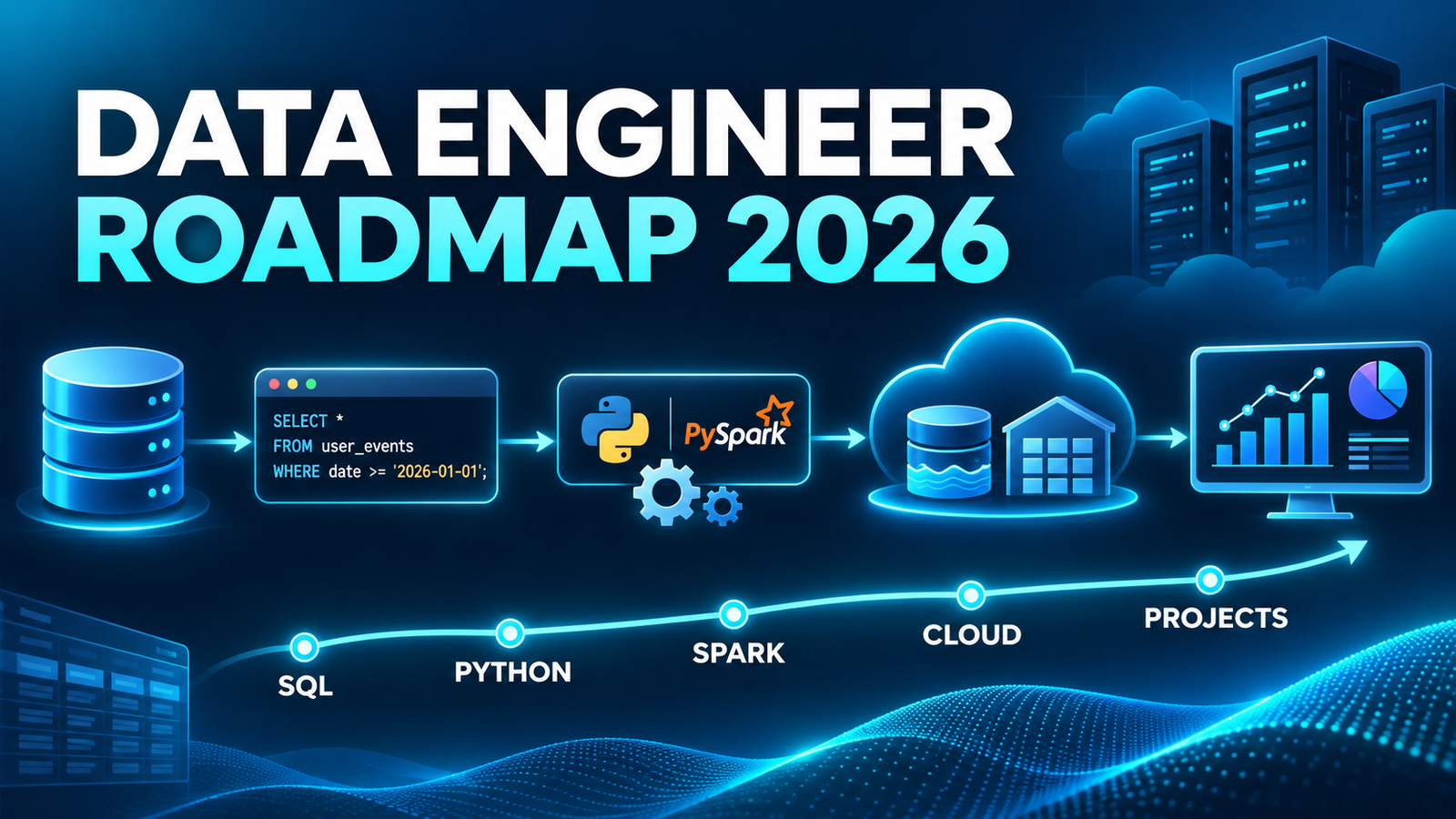
The Data Engineer Roadmap is one of the most searched career paths in tech right now, and for good reason. Every company that collects data needs someone to move it, clean it, store it and make it reliable. Without data engineers, analysts have nothing to analyse and ML models have nothing to learn from.
This pillar guide gives you a step-by-step data engineer roadmap for 2026: what to learn, in what order, how long it takes, which projects to build and which free resources to use. It works for students, fresh graduates, analysts moving into engineering and software developers switching careers.
Quick answer: Learn in this order: SQL → Python → Linux/Git → data modelling and warehousing → Spark → Airflow (orchestration) → one cloud platform → dbt and streaming basics → projects and interviews. With 2-3 focused hours a day, most people become job-ready in 6-12 months.
What Does a Data Engineer Actually Do?
A data engineer builds and maintains the systems that collect, transform, store and serve data. Typical work includes:
- Building ETL/ELT pipelines that pull data from databases, APIs, files and event streams
- Designing data warehouses and lakehouses for analytics
- Making sure data is clean, tested, documented and on time
- Running batch and streaming jobs at scale
- Controlling cost, performance, security and access
- Supporting analysts, data scientists and ML engineers
How it differs from related roles:
| Role | Main focus |
|---|---|
| Data Engineer | Pipelines, storage, infrastructure, data quality |
| Data Analyst | Dashboards, reports, business questions |
| Data Scientist | Statistics, experiments, models |
| Analytics Engineer | Transformations and modelling inside the warehouse (often with dbt) |
| ML Engineer | Deploying and serving models |
Data Engineer Roadmap 2026 at a Glance
| Phase | Focus | Core Skills | Time (approx.) |
|---|---|---|---|
| 1 | Foundations | SQL, Python, Linux, Git | Months 1-2 |
| 2 | Data fundamentals | Databases, data modelling, warehousing, file formats | Month 3 |
| 3 | Processing | Pandas, Spark (PySpark), batch ETL | Months 3-5 |
| 4 | Orchestration | Airflow, scheduling, testing, monitoring | Month 5-6 |
| 5 | Cloud | AWS, Azure or GCP (pick one) | Months 6-8 |
| 6 | Modern data stack | dbt, Snowflake/BigQuery/Databricks, lakehouse | Months 7-9 |
| 7 | Streaming (basics) | Kafka, Spark Structured Streaming | Months 9-10 |
| 8 | Projects and job prep | Portfolio, resume, interviews | Months 10-12 |
Timelines assume 2-3 hours of study daily. If you already know SQL or Python, you can skip ahead and finish faster.
Step 1: Master SQL (Months 1-2)
SQL is the most important skill for a data engineer. Almost every interview tests it, and almost every pipeline touches it.
What to learn:
- SELECT, WHERE, GROUP BY, HAVING, ORDER BY
- All JOIN types (inner, left, right, full, cross, self joins)
- Subqueries and CTEs
- Window functions (ROW_NUMBER, RANK, LAG, LEAD, running totals)
- Aggregations, CASE statements, date and string functions
- Indexes, query plans and basic performance tuning
- Transactions and constraints
- DDL and DML (CREATE, ALTER, INSERT, UPDATE, DELETE, MERGE)
Practice target: Solve at least 100-150 SQL problems, focusing on joins, window functions and aggregation.
Tip: Pick one database (PostgreSQL is an excellent choice) and stick to it while learning.
For more SQL practice and interview questions, see: [Internal Link – Post 5].
Step 2: Learn Python for Data Engineering (Months 1-3)
You do not need to be a software engineer, but you need to write clean, reliable code.
What to learn:
- Python basics: data types, loops, functions, error handling
- Data structures: lists, dicts, sets, tuples
- Working with files (CSV, JSON, Parquet) and APIs (requests library)
- Modules, virtual environments and packaging
- Pandas for data manipulation
- Writing unit tests (pytest)
- Logging, config management and environment variables
- Basic object-oriented programming
- Connecting to databases (SQLAlchemy, psycopg)
Practice target: Build a script that pulls data from a public API, cleans it with Pandas and loads it into PostgreSQL.
See our Python for data engineers guide: [Internal Link – Post 9].
Step 3: Get Comfortable with Linux, Git and the Command Line (Month 2)
Most data infrastructure runs on Linux, and every team uses Git.
What to learn:
- Navigating the file system, permissions, processes
- Shell commands: grep, awk, sed, cron, curl
- Basic shell scripting
- Git and GitHub: branching, merging, pull requests, resolving conflicts
- Docker basics: images, containers, docker-compose
- SSH and basic networking concepts
Docker is increasingly expected, because most local data stacks are run through containers.
Step 4: Understand Databases, Data Modelling and Warehousing (Month 3)
This is where many self-taught learners have gaps, and where strong candidates stand out.
What to learn:
- OLTP vs OLAP systems
- Relational vs NoSQL databases (MongoDB, Redis, Cassandra at a high level)
- Normalisation and denormalisation
- Dimensional modelling: facts, dimensions, star schema, snowflake schema
- Slowly Changing Dimensions (SCD Type 1, 2)
- Data warehouse vs data lake vs lakehouse
- File formats: CSV, JSON, Avro, Parquet, ORC, and why columnar formats matter
- Table formats: Delta Lake, Apache Iceberg, Apache Hudi
- Partitioning, clustering and indexing
- ETL vs ELT
- Data quality, lineage and governance basics
Practice target: Design a star schema for an e-commerce or ride-sharing dataset and implement it in PostgreSQL.
Step 5: Learn Apache Spark and Distributed Processing (Months 3-5)
When data no longer fits on one machine, you need Spark.
What to learn:
- Why distributed computing exists (MapReduce idea, partitions, shuffles)
- Spark architecture: driver, executors, cluster manager
- DataFrames and Spark SQL (focus here first)
- PySpark for transformations, joins, aggregations, window functions
- Lazy evaluation, transformations vs actions
- Partitioning, caching and shuffle optimisation
- Handling skew and the small-files problem
- Reading and writing Parquet, Delta and Iceberg
- Spark UI for debugging performance
- Structured Streaming basics (for later)
Spark is on its 4.x line, so use current documentation and tutorials. Databricks Community/Free Edition is a convenient way to practise without setting up a cluster.
Practice target: Process a multi-million-row dataset in PySpark, write partitioned Parquet output and compare performance with a plain Pandas approach.
Step 6: Learn Workflow Orchestration with Apache Airflow (Months 5-6)
Pipelines must run on schedule, retry on failure and alert you when something breaks. That is orchestration.
What to learn:
- DAGs, tasks, operators, sensors and dependencies
- Scheduling, backfills and catchup
- Task retries, SLAs, alerts
- Connections, variables, secrets
- XComs and passing data between tasks
- The TaskFlow API
- Data-aware scheduling with assets
- Running Airflow locally with Docker
- Testing DAGs and keeping tasks idempotent
Version note: Airflow is now in the 3.x series, which brought a new UI, a re-architected execution model and improved backfills. Most older tutorials are based on Airflow 2.x, so check which version a course uses. Core concepts stay the same.
Alternatives worth knowing: Dagster, Prefect, and cloud-native tools such as AWS Step Functions, Azure Data Factory and Cloud Composer.
Practice target: Build a daily DAG that extracts API data, loads it into a staging table, transforms it and sends a failure alert.
See our orchestration deep-dive: [Internal Link – Post 10].
Step 7: Pick One Cloud Platform (Months 6-8)
Almost all modern data engineering is cloud-based. Learn one platform deeply first. The concepts transfer.
| Cloud | Storage | Warehouse | Processing | Orchestration/ETL |
|---|---|---|---|---|
| AWS | S3 | Redshift | EMR, Glue, Lambda | Glue, MWAA, Step Functions |
| Azure | ADLS Gen2 | Synapse / Fabric | Databricks, Synapse | Data Factory |
| GCP | Cloud Storage | BigQuery | Dataproc, Dataflow | Cloud Composer |
Which one should you pick?
- AWS has the largest market share and the most job postings.
- Azure is strong in enterprises and Microsoft-heavy companies.
- GCP is excellent for learning because BigQuery is easy to start with and has a free tier.
What to learn on your chosen cloud:
- IAM, roles and permissions (security basics)
- Object storage, networking basics
- A managed warehouse
- A managed processing service
- Serverless functions
- Cost management and monitoring
Practice target: Build an end-to-end pipeline fully on one cloud: raw data in object storage, transformed with Spark or SQL, loaded to a warehouse and scheduled.
Consider a cloud certification such as AWS Data Engineer Associate, Azure DP-700 or Google Professional Data Engineer once you have hands-on experience. Check the current exam names and prices on the official vendor sites.
Step 8: Learn the Modern Data Stack: dbt, Warehouses and Lakehouses (Months 7-9)
dbt (data build tool) has become standard for transformations in the warehouse.
What to learn:
- dbt models, sources, refs and materialisations
- Tests, documentation and lineage
- Incremental models and snapshots
- Jinja and macros basics
- Layered modelling (staging, intermediate, marts)
Warehouses and platforms to know:
- Snowflake, BigQuery, Redshift, Databricks
- Concepts: separation of storage and compute, micro-partitions, clustering, cost optimisation
Ingestion tools worth a look: Airbyte, Fivetran, dlt. Data quality tools: Great Expectations, Soda.
Step 9: Learn Streaming Basics (Months 9-10)
You do not need to be a streaming expert at entry level, but you should understand the concepts.
What to learn:
- Batch vs streaming vs micro-batch
- Apache Kafka: topics, partitions, producers, consumers, consumer groups, offsets
- Event time vs processing time, windows, watermarks
- Spark Structured Streaming or Flink basics
- Change Data Capture (CDC) with tools such as Debezium
- Exactly-once vs at-least-once delivery
Practice target: Stream events from a Kafka topic, aggregate them in Spark Structured Streaming and write results to a table.
Step 10: Build Portfolio Projects (Throughout, Focus in Months 10-12)
Projects prove you can actually do the job. Aim for 3-4 solid projects on GitHub, each with a README, architecture diagram and clear instructions.
Project ideas:
- Batch ELT pipeline: API → S3/GCS → warehouse → dbt models → dashboard, orchestrated by Airflow
- Spark lakehouse project: Process large public data into Delta or Iceberg tables with partitioning and incremental loads
- Streaming pipeline: Kafka → Spark Streaming → warehouse with real-time metrics
- Data quality framework: Automated tests, alerts and monitoring on an existing pipeline
- Capstone: An end-to-end platform with CI/CD, Docker, infrastructure as code (Terraform) and documentation
What makes a project stand out:
- Real, messy data, not a perfect toy dataset
- Clear architecture diagram
- Tests and error handling
- Cost and design trade-offs explained
- A short write-up or blog post
For more project ideas and portfolio tips: [Internal Link – Post 16].
6-Month vs 12-Month Study Plan
Fast Track: 6 Months (3-4 hours daily, for those with some background)
| Month | Focus |
|---|---|
| 1 | SQL (advanced), Python for data, Git, Linux |
| 2 | Data modelling, warehousing, PostgreSQL project |
| 3 | PySpark and batch processing |
| 4 | Airflow, Docker, first end-to-end project |
| 5 | Cloud platform, warehouse, dbt |
| 6 | Capstone project, resume, interview practice |
Standard Track: 12 Months (2 hours daily, for beginners)
| Months | Focus |
|---|---|
| 1-2 | SQL fundamentals and intermediate, Python basics |
| 3 | Python for data, Pandas, Linux, Git |
| 4 | Databases, data modelling, warehousing |
| 5-6 | Spark and distributed processing |
| 7 | Airflow, Docker |
| 8-9 | Cloud platform and managed services |
| 10 | dbt, Snowflake/BigQuery/Databricks |
| 11 | Streaming basics, CI/CD, Terraform basics |
| 12 | Projects, portfolio, resume and interviews |
Free Resources to Learn Data Engineering
You can learn everything here without paying anything. Check each site for current availability.
Full courses and bootcamps
- DataTalks.Club Data Engineering Zoomcamp: A free, project-based course covering Docker, Terraform, Airflow-style orchestration, warehouses, dbt, Spark and Kafka
- freeCodeCamp: Free long-form videos on SQL, Python and data engineering
- Databricks Academy and Databricks Free Edition: Free learning paths and a practice environment for Spark
- dbt Learn: Free courses for dbt fundamentals
SQL
- SQLBolt, Mode SQL Tutorial, PostgreSQL official documentation
- Practice sites: LeetCode (SQL), HackerRank, StrataScratch, DataLemur (free tiers available)
Python
- Official Python tutorial, Kaggle Learn (Python and Pandas), Real Python (free articles)
Spark and Airflow
- Official Apache Spark and Apache Airflow documentation
- Astronomer’s free learning resources for Airflow
Cloud
- AWS Skill Builder, Microsoft Learn and Google Cloud Skills Boost all have free content. Free-tier accounts let you practise hands-on, but set billing alerts so you are never surprised by a charge.
Streaming
- Confluent Developer (free Kafka courses and tutorials)
Books (worth buying later)
- Designing Data-Intensive Applications by Martin Kleppmann
- The Data Warehouse Toolkit by Ralph Kimball
- Fundamentals of Data Engineering by Joe Reis and Matt Housley
Data Engineer Interview Preparation
Interviews typically cover:
- SQL: joins, window functions, query optimisation (almost always tested)
- Python: data manipulation and coding problems
- Data modelling: design a schema for a given business case
- System design: design a pipeline or warehouse for a scenario
- Spark: partitions, shuffles, joins, performance tuning
- Cloud and tools: your chosen stack and trade-offs
- Behavioural: past projects, debugging stories, teamwork
Practise by explaining your own projects out loud: why you picked each tool, what failed and what you would change. Find more questions and answers here: [Internal Link – Post 17].
Common Mistakes to Avoid
- Tool-hopping: Learning ten tools shallowly instead of a few deeply
- Skipping SQL and fundamentals to chase Spark or Kafka
- Tutorial hell: Watching endlessly without building
- Ignoring data modelling, which is what separates good engineers from average ones
- Only using clean toy datasets
- Not learning to test and monitor pipelines
- Ignoring cost in cloud projects
- Chasing certificates instead of building proof of work
Data Engineer Roadmap: Skills Checklist
- [ ] Advanced SQL with window functions and CTEs
- [ ] Python, Pandas, APIs and testing
- [ ] Linux, Git, Docker
- [ ] Data modelling and warehousing concepts
- [ ] Parquet, Delta/Iceberg, partitioning
- [ ] PySpark and performance tuning
- [ ] Airflow (or similar) orchestration
- [ ] One cloud platform in depth
- [ ] dbt and a cloud warehouse
- [ ] Kafka and streaming basics
- [ ] 3-4 portfolio projects on GitHub
- [ ] Resume, LinkedIn and interview practice
FAQs: Data Engineer Roadmap
1. How long does it take to become a data engineer?
Typically 6-12 months of consistent study with projects. It depends on your background and daily hours.
2. Do I need a computer science degree?
No. Many data engineers come from analytics, software or non-CS backgrounds. Skills and projects matter more.
3. Should I learn SQL or Python first?
Start with SQL, then add Python. You can learn both in parallel after the first few weeks.
4. Is Spark still worth learning in 2026?
Yes. Spark remains a core engine for large-scale processing and is actively developed. Learn DataFrames and Spark SQL first.
5. Which cloud should I learn first?
AWS has the most job openings, Azure is common in enterprises and GCP is beginner-friendly. Pick one and go deep.
6. Is data engineering a good career in 2026?
Demand remains strong because AI and analytics both depend on reliable data pipelines. Salaries and openings vary by country and company, so check current job listings in your market.
7. Can freshers become data engineers?
Yes, with strong SQL, Python, a couple of end-to-end projects and cloud basics. Many start as data analysts, BI developers or junior engineers.
Final Words
The data engineer roadmap is a long road, but it is clear. Master SQL and Python, understand data modelling, learn Spark and Airflow, pick one cloud, add dbt and finish with real projects. Stay consistent, build in public and keep your focus on fundamentals over fashionable tools. In 6-12 months you can move from beginner to job-ready.





Leave a Reply