
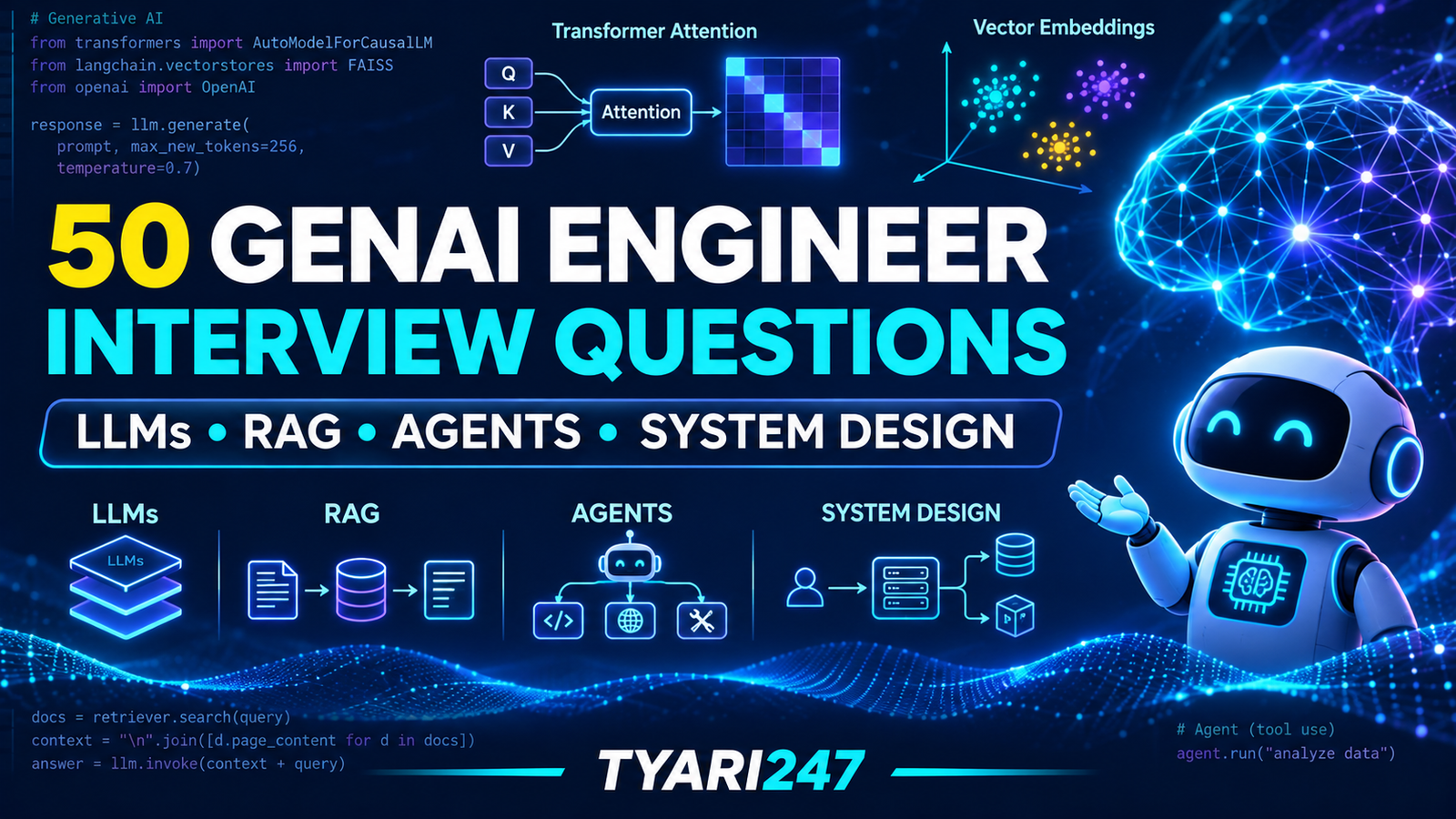
Generative AI engineering interviews increasingly test how you build and operate real systems—not only whether you know terms like Transformer or embeddings. Interviewers may ask you to diagnose a weak RAG pipeline, choose between fine-tuning and retrieval, control hallucinations, secure tool-using agents, or reduce inference costs.
This guide contains 50 GenAI Engineer Interview Questions and answers, grouped by topic. Use the answers as starting points, then explain how you would apply each idea in a project.
1. LLM and Transformer Fundamentals
1. What is a large language model?
A large language model is a neural network trained on large amounts of data to predict or generate token sequences. During inference, it receives a context and produces likely next tokens. The model’s output is shaped by its training, prompt, decoding settings, and any external context or tools provided to it.
2. What is a token, and why does tokenization matter?
A token is a unit used by a model to represent text. It may be a word, part of a word, punctuation mark or other symbol. Tokenization matters because context limits and many inference costs are measured in tokens. Unusual spellings, code, long identifiers and some languages can use more tokens than expected.
3. Explain self-attention in a Transformer.
Self-attention lets each token weigh information from other tokens in the input. The model creates query, key and value representations. Similarity between queries and keys determines attention weights, which are used to combine values. This helps the model represent relationships across a sequence.
4. What is multi-head attention?
Multi-head attention runs several attention operations in parallel. Each head can learn different relationships, such as local syntax or longer-range dependencies. Their outputs are combined and projected into a shared representation.
5. What is the difference between an encoder-only, decoder-only and encoder-decoder model?
- Encoder-only models build contextual representations and are often used for classification or embeddings.
- Decoder-only models predict the next token and are commonly used for text generation.
- Encoder-decoder models encode an input and generate an output, which suits tasks such as translation and summarization.
6. What is the difference between pretraining and fine-tuning?
Pretraining teaches a model broad patterns from large datasets, often through next-token prediction or another self-supervised objective. Fine-tuning adapts an existing model using a smaller, task-specific dataset to improve its behaviour for a particular use case.
7. What do temperature and top-p control?
They control the randomness of token selection during generation. A lower temperature generally makes outputs more predictable. Top-p sampling limits candidate tokens to a set whose cumulative probability reaches a chosen threshold. Neither setting guarantees factual accuracy.
8. What is the context window?
The context window is the maximum number of tokens a model can consider in a request, including input and often generated output. A larger window can hold more information, but using it may increase latency and cost. It can also make relevant facts harder to retrieve from a long prompt.
9. Why do LLMs hallucinate?
An LLM generates likely text rather than verifying every statement against a trusted source. Hallucinations can result from missing evidence, ambiguous prompts, outdated model knowledge, weak retrieval, conflicting context or pressure to provide an answer when information is insufficient.
10. How do you make a model return structured JSON?
Use a schema-constrained output feature if the model or API supports it. Define required fields, types, enums and constraints; validate the result in application code; and handle invalid or incomplete outputs. A prompt that merely asks for JSON is not a substitute for validation.
2. Prompt Engineering and Model Adaptation
11. What makes a prompt effective?
An effective prompt clearly states the task, provides relevant context, defines constraints and describes the expected output. For complex tasks, include examples and specify how to handle missing information. Keep instructions separate from untrusted user-provided content.
12. What is few-shot prompting?
Few-shot prompting provides a small number of examples in the prompt to demonstrate the desired input-output pattern. It can help a model follow a format or task style without updating model weights, but examples consume context and may bias the response.
13. How do you handle conflicting instructions in a prompt?
Define an instruction hierarchy in the application, keep trusted system instructions separate from user content, and explicitly label retrieved documents as untrusted data. The application should enforce permissions and policies; do not rely on prompt wording alone for security.
14. What is prompt injection?
Prompt injection is an attempt to manipulate a model through instructions embedded in user input, retrieved content or tool output. For example, a document may tell the model to ignore prior rules and reveal secrets. Defences include treating external text as data, limiting tools, enforcing permissions outside the model and validating actions.
15. When would you fine-tune a model instead of using RAG?
Fine-tuning is useful when you need to change consistent behaviour, style, task patterns or domain-specific output format. RAG is usually more suitable when the model needs access to changing or private facts that must be traceable to source documents. The approaches can also be combined.
16. What is LoRA?
LoRA, or Low-Rank Adaptation, is a parameter-efficient fine-tuning method. It freezes most base-model weights and trains smaller low-rank matrices added to selected layers. This can reduce the number of trainable parameters and the resources needed compared with updating the entire model.
17. What is the difference between full fine-tuning and parameter-efficient fine-tuning?
Full fine-tuning updates most or all model parameters and can require substantial compute and storage. Parameter-efficient methods such as LoRA train a smaller set of added parameters. The right choice depends on task complexity, available data, compute budget, deployment constraints and measured quality.
18. What data checks do you perform before fine-tuning?
Check that the data is relevant, correctly labelled, representative and legally usable. Remove duplicates and sensitive information where required. Separate training, validation and test sets to prevent leakage. Inspect examples manually and measure performance on realistic edge cases.
19. How do you reduce overfitting during fine-tuning?
Use a representative dataset, a separate validation set, appropriate training duration and regularization where applicable. Track task-specific metrics and compare against the base model. Stop or adjust training if validation performance worsens while training performance improves.
20. What is catastrophic forgetting?
Catastrophic forgetting occurs when fine-tuning on new data weakens capabilities the model previously had. It can be reduced by using high-quality, balanced data, carefully tuning learning rates and training duration, and evaluating both the target task and important general capabilities.
3. Retrieval-Augmented Generation and Vector Search
21. What is Retrieval-Augmented Generation (RAG)?
RAG retrieves relevant external information and provides it to a language model as context for generating an answer. It combines the model’s language-generation ability with an external knowledge source, which can make answers more current and easier to ground in evidence.
22. What are the main stages of a RAG pipeline?
A typical pipeline includes:
- Ingest and extract documents.
- Clean and split the content into chunks.
- Generate embeddings and store them with metadata.
- Retrieve relevant chunks for a query.
- Optionally rerank or filter retrieved results.
- Build a grounded prompt and generate an answer.
- Return source references and log results for evaluation.
23. How do you choose a chunking strategy?
Choose chunk size and overlap based on document structure and the task. Small chunks can improve precise retrieval but may lose context. Large chunks preserve context but can include irrelevant text. Test different strategies using retrieval and answer-quality evaluations rather than selecting a size by intuition alone.
24. What is an embedding?
An embedding is a vector representation of text or another input. Similar meanings are intended to have nearby vectors in the embedding space. Embeddings support semantic search, clustering and similarity comparisons, but similarity alone does not prove that a passage answers a query.
25. What is the difference between dense and sparse retrieval?
Dense retrieval compares learned vector representations and can find semantically related text even when wording differs. Sparse retrieval, such as keyword-based search, is effective for exact terms, product codes and rare identifiers. A hybrid approach can use both.
26. What is hybrid search?
Hybrid search combines lexical search with semantic vector search. It can improve results when queries contain both meaning-based language and exact keywords. The two result sets can be merged or reranked, with the approach evaluated on a representative query set.
27. What is reranking, and when would you use it?
Reranking applies a more expensive relevance model to an initial set of retrieved candidates. It can improve the ordering of results before they are sent to the generator. It is useful when initial retrieval finds relevant documents but ranks them poorly, though it adds latency and cost.
28. How do you evaluate a RAG system?
Evaluate retrieval and generation separately. Retrieval metrics can include Recall@k, Precision@k and ranking metrics such as MRR or nDCG. Generation checks can measure answer relevance, correctness against evidence, faithfulness, citation accuracy and refusal behaviour. Combine automated tests with human review.
29. How would you debug a RAG system that gives irrelevant answers?
Inspect the full pipeline in order: query interpretation, filters, retrieved chunks, ranking, context assembly and final prompt. Check whether the answer is present in the indexed source, whether metadata filters are correct, and whether chunking or embedding choice is hurting retrieval. Add a regression test for the failure.
30. How do you reduce hallucinations in RAG?
Improve retrieval quality, provide only relevant evidence, instruct the model to distinguish supported facts from uncertainty, and require citations where appropriate. Validate that citations point to the supplied sources. If evidence is insufficient, the application should allow a “not enough information” response.
4. Agents, Tools and MCP
31. What is an AI agent?
An AI agent is a system in which a model selects actions, uses tools or interacts with an environment to complete a task. A production agent also needs control flow, state handling, permissions, error handling and limits on steps or resources.
32. How is an agent different from a standard LLM call?
A standard LLM call returns a response from provided inputs. An agent can make multiple decisions, call tools, observe their outputs and continue. This makes agents useful for multi-step tasks but creates more opportunities for errors, latency and unsafe actions.
33. What is tool calling?
Tool calling allows a model to request a structured action, such as looking up an order or running a calculation. The application validates the request, executes the tool under controlled permissions and returns the result to the model. A tool call is a proposal from the model, not authorization by itself.
34. How do you make an agent reliable?
Give it a narrow goal, a small and well-described tool set, bounded retries and a maximum step count. Validate tool arguments, use deterministic code for critical operations, persist important state and log each action. Add fallbacks and human approval for high-impact actions.
35. What is MCP?
The Model Context Protocol (MCP) is an open protocol for connecting AI applications with external data sources and tools. It standardizes how clients and servers exchange context and capabilities. MCP does not replace authentication, authorization or application-level safety controls.
36. How would you secure an agent that can use tools?
Apply least privilege, authenticate users and tools, validate arguments, restrict access to approved resources and record actions. Require confirmation for sensitive or irreversible operations. Do not let the model directly decide access rights; enforce permissions in trusted application code.
37. When should you avoid using an agent?
Avoid an agent when a simple deterministic function or workflow can solve the task more reliably. Agents add model uncertainty, tool-call overhead and operational complexity. Use them when flexible reasoning and multi-step tool use provide measurable value.
5. Evaluation, Safety and Production Operations
38. What is an LLM evaluation dataset?
It is a curated set of inputs and expected properties or outcomes used to assess a model or application. Depending on the task, examples may include expected answers, source evidence, acceptable formats, safety labels or scoring rubrics. It should represent real users and difficult cases.
39. Why are traditional accuracy metrics often insufficient for GenAI?
Generated answers can vary in wording while conveying the same meaning. Exact-match scores may mark valid answers wrong, while a fluent answer can still be false. Evaluation often needs multiple checks: semantic correctness, evidence support, format compliance, safety and human judgment.
40. What is an LLM-as-a-judge, and what are its limitations?
An LLM-as-a-judge uses a model to score or compare outputs. It can help scale evaluation, but may prefer longer or stylistically similar responses, miss subtle factual errors, or show bias. Calibrate it against human ratings, use clear rubrics and periodically review disagreements.
41. What metrics would you monitor in a production GenAI application?
Monitor quality, latency, error rate, token usage, cost per successful task, retrieval quality, tool-call success, refusal rates and user feedback. Track performance by model version, prompt version, task type and user segment while respecting privacy requirements.
42. How do you control inference cost?
Use the smallest model that meets quality requirements, shorten unnecessary prompts, retrieve only relevant context, cap output length and cache repeatable results. Route tasks by complexity and monitor cost per completed user task—not only the price of an individual model call.
43. How do you reduce latency in a RAG application?
Profile each stage separately. Improve document retrieval, avoid unnecessary reranking or tool calls, stream output where useful, cache safe repeated work and reduce prompt size. Parallelize independent operations when possible, while preserving correctness and access controls.
44. How do you protect sensitive data in a GenAI system?
Minimize data sent to the model, redact or tokenize sensitive fields where practical, enforce access controls before retrieval, encrypt data in transit and at rest, and define retention policies. Review provider and organizational data-handling requirements, and avoid logging secrets or unnecessary personal data.
45. How do you handle prompt and model versioning?
Version prompts, models, retrieval settings, embedding models and evaluation datasets. Record the versions used for each request where appropriate. Run regression evaluations before rollout and use gradual deployment or a rollback path if quality or operational metrics deteriorate.
6. System Design and Scenario Questions
46. Design a support chatbot over thousands of policy documents.
I would build a document ingestion pipeline with extraction, cleaning, metadata tagging, chunking, embeddings and hybrid search. At query time, I would apply user permissions, retrieve and rerank relevant chunks, generate an answer grounded in those sources and return citations. I would evaluate retrieval and answer quality, log failures and include a clear fallback when evidence is missing.
47. A RAG chatbot gives stale answers after documents are updated. What would you investigate?
Check the source-of-truth update process, ingestion schedule, document versioning and index refresh. Confirm old chunks are removed or superseded and that caches are invalidated. Add an update-to-search freshness metric and test a known changed document end to end.
48. How would you prevent a chatbot from exposing documents a user cannot access?
Enforce authorization before or during retrieval using trusted identity and document-level access metadata. Do not retrieve broadly and ask the model to hide restricted content afterward. Test with users who have different permission sets and audit access decisions.
49. A model produces correct answers but users complain about long delays. What do you do?
Measure latency by component: model time, retrieval, reranking, tools, network and queueing. Then optimize the dominant stage. Possible changes include using a faster model for simpler queries, streaming, reducing context, caching safe responses or removing unnecessary calls. Validate that quality remains acceptable.
50. How would you decide between a hosted model and self-hosting an open model?
Compare quality on the actual task, latency, throughput, privacy requirements, availability, deployment effort and total cost. A hosted model may reduce infrastructure work; self-hosting can provide more control but requires capacity planning, serving expertise and ongoing operations. Decide with a measured workload benchmark and a realistic cost model.
How to Prepare for a GenAI Engineer Interview
- Be ready to explain one complete project: the problem, architecture, trade-offs, evaluation and lessons learned.
- Practise diagnosing failures across ingestion, retrieval, prompting, generation and application logic.
- Explain why you chose RAG, fine-tuning, tools or a simpler deterministic workflow.
- Bring measurable results where possible, such as answer quality, latency, cost or retrieval recall.
- Discuss security and failure handling as part of the design, not as an afterthought.
- Be honest about what you have built and what you have only studied.
Final Note
Strong answers connect model concepts to engineering decisions. When asked about a technique, explain what problem it solves, what it costs, how you would evaluate it and what could go wrong in production.




Leave a Reply